Rules
How to Play Werewolf (Mafia): Complete Rules Guide
Full rules for Werewolf and Mafia — setup, night actions, day voting, roles, and practical table flow.
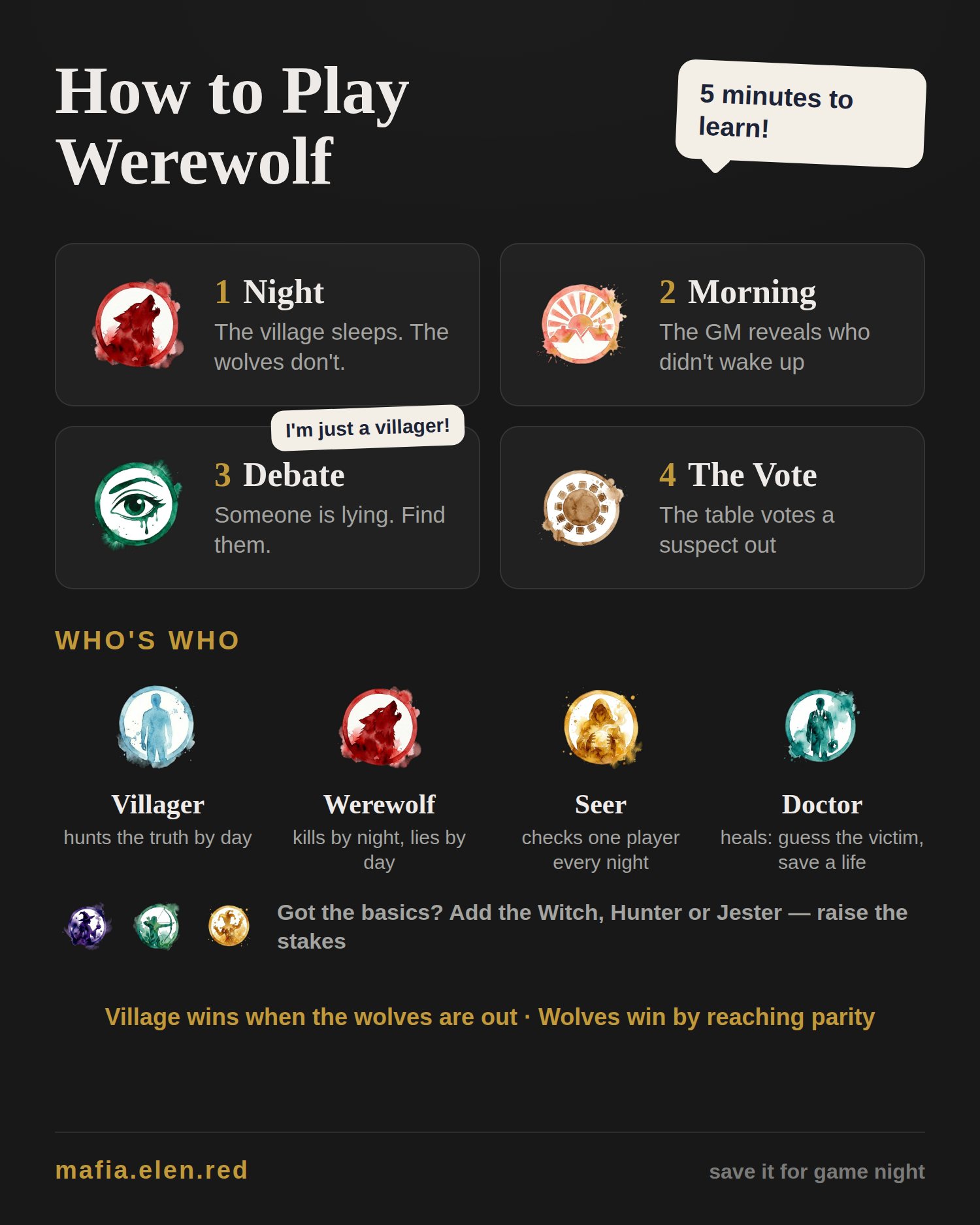
Werewolf is a party game where a small group of secret killers (the Werewolves) tries to take out everyone while the rest of the table (Villagers) tries to figure out who they are. The game needs at least 6 players and one Game Master who runs the show.
No cards, no board, no app required — though a game master tool makes everything smoother.
What You Need
- 6–16 players (8–12 is the sweet spot)
- 1 Game Master (GM) who doesn't play but runs the game
- A way to assign roles secretly — folded paper slips, a deck of cards, or a phone app
Teams
There are two main teams, plus optional independent roles:
- Villagers (the majority) — they don't know anyone's role and must find the Werewolves through discussion
- Werewolves (2–4 players) — they know each other and secretly agree on one player to eliminate each night
- Independent roles like the Maniac act alone with their own win conditions
See our complete role guide for every role explained.
Setup
- The GM decides which roles are in the game based on the number of players
- Roles are assigned randomly and secretly — each player sees only their own role
- A good ratio is roughly 1 Werewolf for every 3–4 Villagers
| Players | Werewolves | Villagers | Special roles |
|---|---|---|---|
| 6 | 2 | 4 | Seer, Doctor |
| 8 | 2 + Alpha Wolf | 5 | Seer, Doctor |
| 10 | 2 + Alpha Wolf | 7 | Seer, Doctor, Lover |
| 12 | 3 + Alpha Wolf | 8 | Seer, Doctor, Lover, Courtesan |
For detailed recommendations for every group size, see setup by player count.
Game Flow
The game alternates between two phases: Night and Day.
Night Phase
The GM says: "The village falls asleep." Everyone closes their eyes.
The GM then wakes each role one at a time:
- Werewolves — open your eyes, silently agree on one player to eliminate. Close your eyes.
- Alpha Wolf (if playing) — open your eyes, point at a player. The GM nods or shakes their head to indicate whether that player is the Seer. Close your eyes.
- Seer — open your eyes, point at a player. The GM nods or shakes their head to indicate whether that player is a Werewolf. Close your eyes.
- Doctor — open your eyes, point at a player to protect tonight. Close your eyes.
- Other roles act in turn depending on the variant.
The GM resolves the night: if the Doctor protected the Werewolves' target, nobody is lost. Otherwise, the target is eliminated.
First Night
The first night is usually special:
- Werewolves meet and see each other, but may or may not pick a target (depending on house rules)
- Special roles only reveal themselves to the GM — no actions yet
- The Doctor may or may not be active on the first night
Day Phase
The GM says: "The village wakes up." Everyone opens their eyes.
The GM announces who was lost during the night (without revealing their role in some variants).
Then the town discusses:
- Discussion — players debate who they think is a Werewolf. Accusations, defenses, bluffs.
- Nominations — any player can nominate someone for a vote. Multiple nominations are allowed.
- Vote — the town votes on each nominee. The player with the most votes is eliminated.
- Role reveal — the voted-out player's role is shown (in most variants).
Win Conditions
- Villagers win when all Werewolf members and the Maniac (if present) have been eliminated
- Werewolves win when they equal or outnumber the remaining Villagers and no Maniac remains
- Independent roles (like the Maniac) have their own win conditions
The First Night: Move or No Move?
One of the biggest house-rule decisions:
First Night Move ON:
- Werewolves pick a target on night one
- Doctor is also active and can save someone
- The game starts with action immediately
First Night Move OFF:
- Night one is just for introductions — Werewolves meet, roles say hello to the GM
- No one is taken out on the first night
- Gives players a chance to observe behavior before anyone is lost
Key Rules Variants
Open vs Closed Werewolf
Open Werewolf (Classic): All Werewolf members wake up together and silently agree on a target. They can see each other and communicate with gestures.
Closed Werewolf: Each Werewolf member wakes up separately and points at their target. If all targets match, the action succeeds. If they disagree, nothing happens. This makes coordination harder and more interesting.
Role Reveal on Elimination
- Roles revealed: When you're out, your role is shown. Gives the town more information.
- Roles hidden: The GM says nothing about the removed player's role. Much harder for Villagers.
Last Words
- Allowed: The outgoing player gets a final statement. They can share suspicions, reveal their role, or bluff.
- Forbidden: Removes the power of last-moment information dumps.
Tips for the Game Master
- Keep the pace. Night should take 30–60 seconds per role. Day discussion works best at 3–5 minutes.
- Be theatrical. Narrate the night with flavor. "A shadow creeps through the streets..."
- Stay neutral. Don't give away information through your tone or reactions.
- Track everything. Who was checked, who was healed, who was blocked — it adds up fast. A game master tool helps.
- Start simple. For new groups, use only Werewolves + Seer + Doctor. Add roles as players get experienced.
For a full hosting script with exact phrases, see our Game Master script.
Common Mistakes
- Too many special roles. With 8 players, you don't need a Lover, Courtesan, Maniac, AND a Doctor. Keep it balanced.
- Slow nights. If the GM fumbles the order or forgets who does what, the game drags. Practice the sequence.
- Passive Villagers. If nobody talks, the Werewolves win easily. Encourage debate.
- Revealing roles too early. The Seer who announces themselves on day one is usually eliminated on night two.
See Also
Ready to Play?
Don't want to memorize the night order and count votes by hand? The game master app tracks Seer checks, Doctor heals, Courtesan blocks — and shows the morning result automatically. The game master just tells the story.