Beginner guide
What Is the Werewolf Game? (aka Mafia)
An accessible intro to Werewolf, also known as Mafia — where it came from, why people love it, and how the game master fits in.
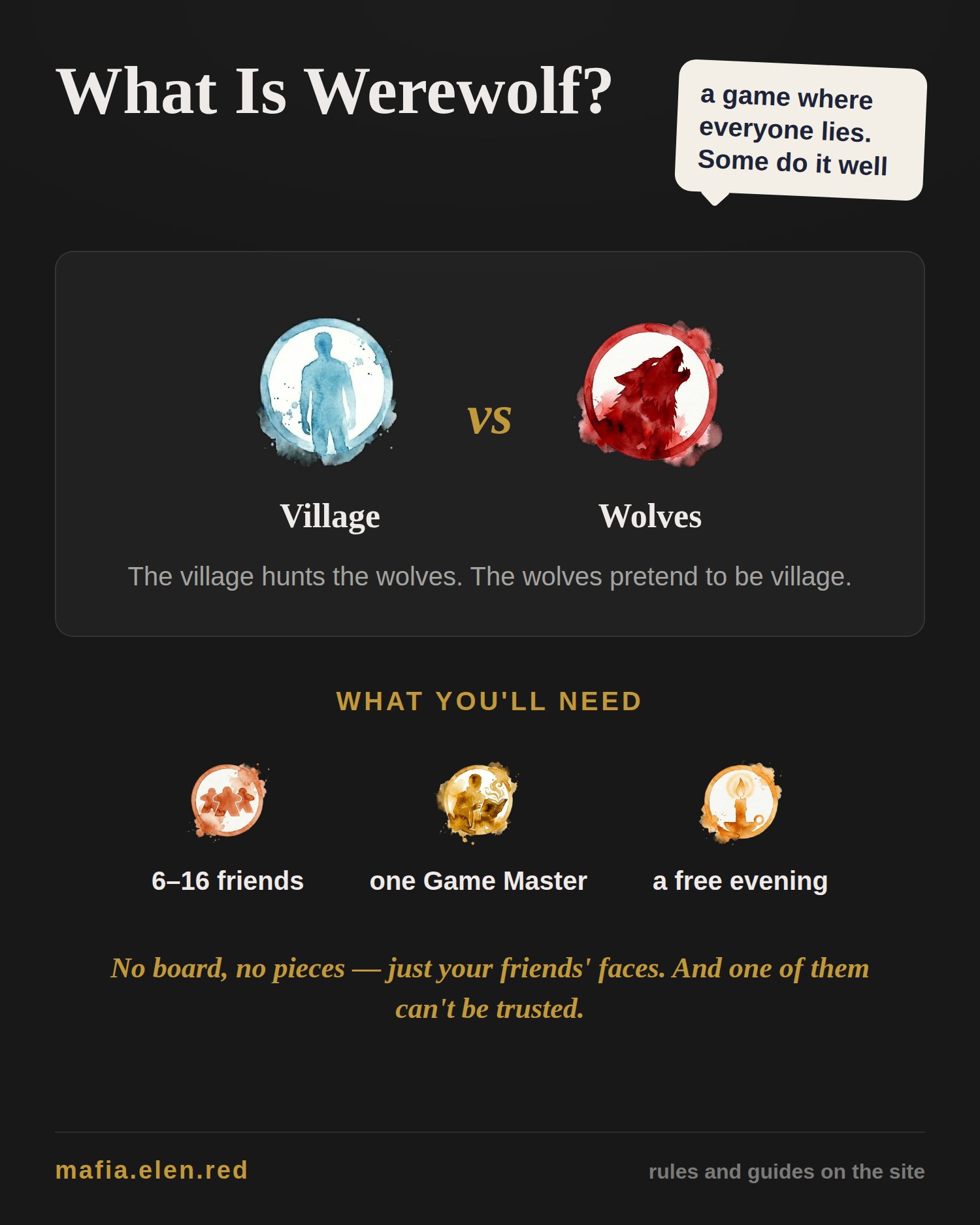
Werewolf is a social deduction party game where players are secretly divided into two teams: innocent Villagers and hidden Werewolves. The Villagers try to figure out who the Werewolf members are and vote them out. The Werewolves try to eliminate Villagers one by one without getting caught. It's a game of lying, reading people, and trusting your gut.
The Basics in 30 Seconds
- 6–16 players sit in a circle. One person is the Game Master (GM).
- Everyone is secretly assigned a role: most are Villagers, a few are Werewolves.
- The game alternates between Night (eyes closed, Werewolves secretly pick someone to take out) and Day (everyone debates and votes to eliminate a suspect).
- Villagers win if they vote out all Werewolves. Werewolves win if they equal or outnumber the Villagers.
That's it. Everything else — special roles, house rules, variants — builds on this core. For the full rules, see our complete rules guide.
Where Did It Come From?
The game was invented in 1986 by Dimitry Davidoff, a psychology student at Moscow State University. He designed it as a thought experiment about informed minorities versus uninformed majorities. The original version was called "Mafia" and had no special roles — just Villagers and Werewolves (originally themed as citizens and mafia). Over time, players added roles like the Seer (who can investigate players), the Doctor (who can save someone), and dozens more.
From Moscow, the game spread to European universities in the 1990s, then to American college campuses. In the West, it got the Werewolf theme — villagers vs werewolves — which became the dominant version worldwide.
Today it's played worldwide — in Russian clubs, at American house parties, on Korean variety shows, and in Iranian cafes where it's a cultural phenomenon.
Why People Love It
No equipment needed. You can play with nothing but people. No board, no cards, no screen.
It's about reading people. Unlike most party games, Werewolf is fundamentally about human psychology. Can you tell when your friend is lying? Can you lie convincingly to a room full of people staring at you?
Everyone is involved. There's no waiting for your turn. Day phase is a free-for-all debate where everyone talks, accuses, defends, and bluffs.
It scales. Works with 6 people at a dinner table or 16 people at a party. The dynamics change with group size, but the game works.
Every round is different. The same group of friends will produce completely different games depending on role assignments, alliances, and who happens to make a suspicious face at the wrong moment.
How It's Different From Board Games
Werewolf has no board, no dice, no resource management. It's closer to an improv exercise than a traditional game. The core mechanic is conversation — persuading other people that you're telling the truth (or that someone else isn't).
This makes it polarizing. People who love debate and social reading adore it. People who prefer clear rules and strategy over social maneuvering might not click with it at first.
The Role of the Game Master
One person doesn't play — they run the game. The Game Master:
- Assigns roles at the start
- Narrates the night phase ("The village falls asleep...")
- Wakes each role in turn and records their choices
- Resolves night actions (eliminations, heals, blocks)
- Announces results in the morning
- Manages day discussion and voting
Being GM is a skill. A good GM keeps the pace fast, narrates with flair, and tracks everything without mistakes. Need a ready-made script? See our complete GM hosting guide.
A game master tool helps by handling role assignment, action tracking, and resolution automatically.
Common Versions
Classic (Mafia variant)
The original version, themed as Citizens vs Mafia, plus Seer (called Sheriff) and Doctor. Played widely in Russia and post-Soviet countries with a strong competitive tournament scene.
The Werewolves of Miller's Hollow
The European/American variant. Villagers vs Werewolves, with roles like the Seer, Witch, Hunter, and Cupid.
One Night Ultimate Werewolf
A fast variant where the entire game is one night plus one day. Roles can swap during the night, so you might not even be who you started as. Games last 10 minutes.
Competitive (Sports) Werewolf
A formalized tournament format popular in Russia. Exactly 10 players, 4 roles only (Villager, Seer, Werewolf, Alpha Wolf), timed speeches, strict rules. There's an international federation (FIIM) and championship tournaments.
Among Us
The 2020 video game that brought social deduction to mainstream audiences. It's not Werewolf exactly, but the DNA is the same: impostors (Werewolves) sabotage and eliminate, crewmates (Villagers) discuss and vote.
Is It the Same as Mafia?
Yes. Werewolf and Mafia are the same game with different theming. Read more about the differences →
See Also
Want to Try It?
Gather 6+ friends and open the game master app — it assigns roles in 10 seconds, runs the night phase, and tells you who to wake next. No cards or paper needed.